
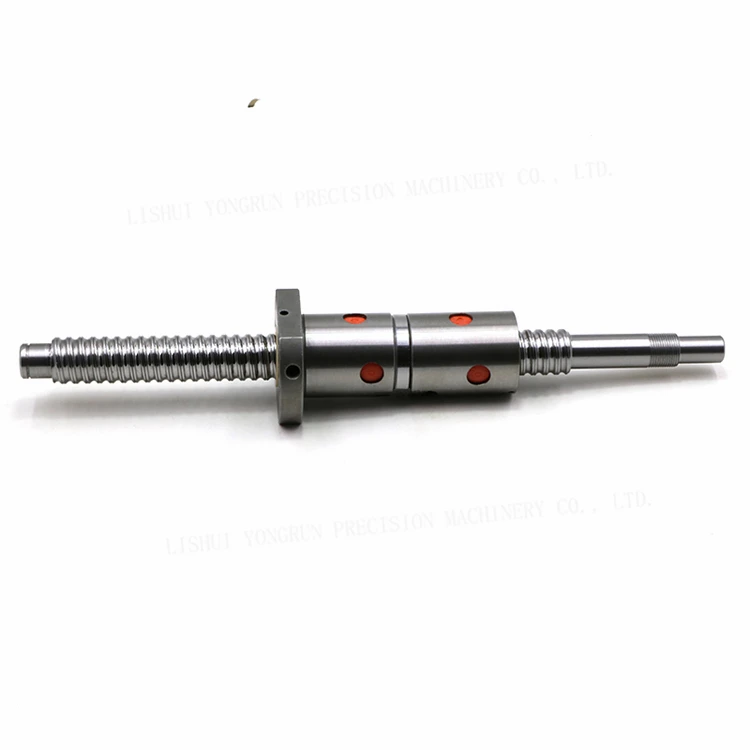
1. The Preload Mechanism (Opposing Axial Forces)
The fundamental design principle of the DFU series is the generation of internal preload via tension.
Structure: The assembly consists of two matched ball nuts mounted on a single screw shaft, separated by a precision-ground spacer (washer).
Mechanism: The spacer thickness exceeds the natural gap between the nuts. When tightened, the nuts are forced apart against the spacer, generating opposing axial vectors.
Result: This tension forces the ball bearings in the first nut against one side of the raceway (flank) and the balls in the second nut against the opposite flank. This effectively removes 100% of internal clearance.
2. Elimination of Backlash (Zero Hysteresis)
In standard single-nut designs, a small axial clearance is required for ball rolling, creating a "Dead Zone" during direction reversals. The DFU architecture eliminates this.
Instant Engagement: Because the opposing nuts are constantly pre-stressed against the raceways, there is no gap to cross when the motor reverses.
Load Transfer: During forward motion, the primary nut bears the load while the secondary nut maintains contact; upon reversal, the load transfer is instantaneous.
Benefit: This ensures immediate system response. If the motor commands a 1-micron increment, the load moves exactly 1 micron, with zero lost motion.
3. Enhanced Dynamic Stiffness (Variable Spring Constant)
Mechanically, a ball screw functions like a steel spring that compresses under load.
Single Nut: Possesses a lower spring constant, leading to deflection under heavy cutting forces.
Double Nut (DFU): Due to the preloaded state, the system is essentially "pre-compressed." It requires significantly higher force to induce further deformation.
Engineering Advantage: This high static stiffness effectively dampens vibrations from machining operations (e.g., milling or grinding), preventing tool chatter and improving surface finish.
4. DIN Standard Interchangeability
The "U" in DFU signifies compliance with the DIN 69051 Form B standard.
Design Logic: Despite the extended length of the double nut, the mounting flange utilizes the standard "trimmed" geometry (flattened top and bottom).
Upgrade Path: This allows engineers to upgrade existing machinery from standard SFU (Single) screws to high-precision DFU (Double) screws without modifying the mounting brackets (e.g., DSG housings), provided sufficient axial clearance exists.