
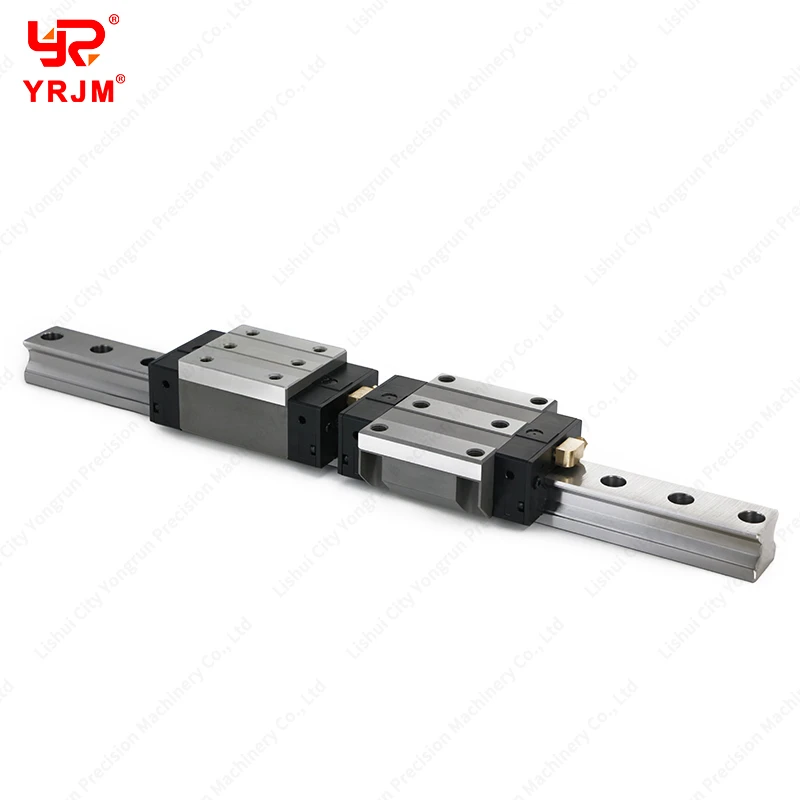
1. Cylindrical Rollers & Line Contact (High Structural Rigidity)
The primary mechanical advantage of the RG Series lies in the contact geometry of its rolling elements.
- Point Contact (Balls): In traditional ball-type guides, spherical rolling elements contact the raceways at microscopic points. Under heavy loads, these point contacts undergo elastic deformation, resulting in axial or radial deflection.
- Line Contact (Rollers): The RG Series utilizes cylindrical rollers that contact the guide rail along a flat, linear region. This design distributes the payload across a significantly larger surface area.
- The Benefit: Elastic deformation is significantly reduced. The RG Series provides exceptional rigidity, minimizing carriage deflection under heavy machining forces and helping to prevent tool chatter.
2. Symmetrical 4-Way Load Capacity (45° Contact Angle)
Inside the high-strength block, the four rows of cylindrical rollers are arranged at a 45-degree contact angle.
- The Mechanics: This symmetrical layout ensures identical load-carrying capacities and high stiffness in all four primary directions: radial (downward), reverse-radial (upward), and lateral (sideways).
- The Benefit: Whether the machine axis is mounted horizontally, vertically, or inverted on an overhead gantry, the RG Series delivers consistent performance and structural stiffness regardless of orientation.
3. Extended Operating Lifespan via Stress Distribution
Because standard ball-type guides concentrate loads on single points, they are more susceptible to localized material fatigue (spalling) over high-cycle use.
- The Mechanics: By distributing the contact pressure evenly along a linear region instead of a single point, the RG Series significantly reduces peak stress concentration.
- The Benefit: Pitting and wear are minimized, resulting in a substantially longer nominal service life under continuous, heavy-load industrial operation.
4. FEM-Optimized Recirculation (Smooth Linear Travel)
Rolling elements must transition smoothly from the load zone to the return path to prevent mechanical vibration.
- The Design: Finite Element Method (FEM) analysis was utilized during the engineering of the RG Series to optimize the internal structure of both the rail and the block.
- The Benefit: The optimized internal circulation paths guide the heavy rollers through the end caps with minimal resistance. This results in quieter, more fluid linear travel compared to older roller-type designs.