
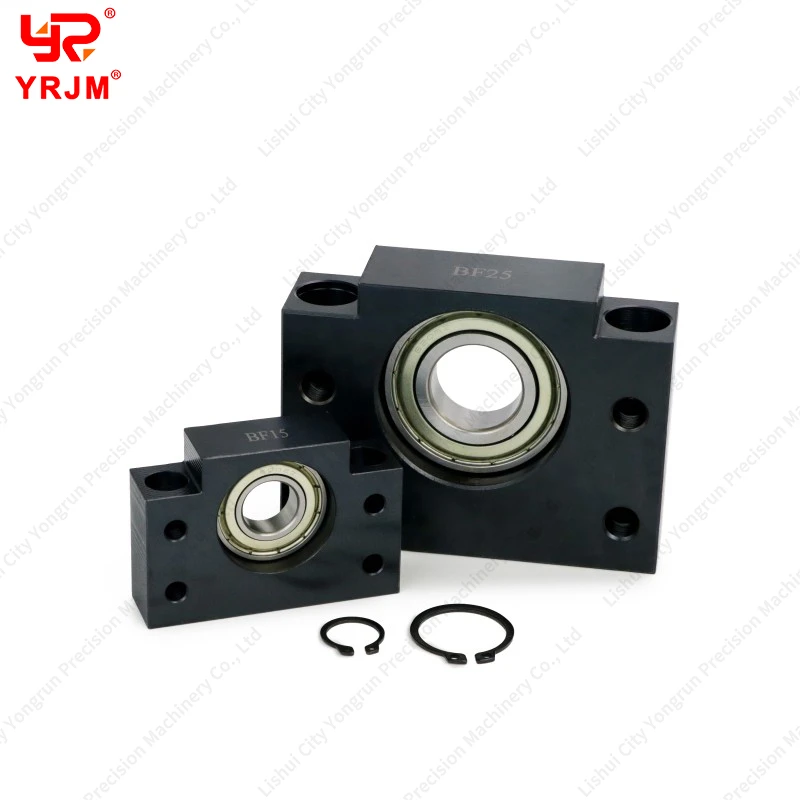
BK and BF support units are essential components in ball screw drive assemblies. They support and locate the screw shaft, help maintain alignment, and provide stable operation during linear motion.
A properly selected and installed support arrangement helps control shaft deflection, reduce vibration, and maintain the positioning performance of the overall drive system.
1. What Are BK and BF Ball Screw Support Units?
BK and BF units are commonly used together in a fixed-supported ball screw mounting arrangement. Each unit serves a different function.
BK Support Unit – Fixed End
The BK support unit is typically installed at the motor or drive end of the ball screw. It commonly incorporates a pair of angular contact ball bearings to support axial loads in both directions and provide axial positioning of the screw shaft.
The bearing arrangement and preload help maintain axial stiffness and minimize unwanted shaft movement. Exact bearing configurations and preload specifications vary by model.
BF Support Unit – Supported End
The BF support unit is generally installed at the opposite end of the ball screw. It commonly uses a deep-groove ball bearing to provide radial support while allowing the shaft to accommodate thermal expansion, depending on the bearing and housing design.
This fixed-supported arrangement helps maintain shaft alignment while reducing unwanted axial constraints.
2. Key Functions and Benefits of BK and BF Support Units
Improved Shaft Support
Supporting the ball screw at both ends helps reduce shaft deflection and maintain alignment, particularly on longer screw assemblies.
Better Vibration Control
Proper bearing support and installation help improve shaft stability and reduce vibration during operation, especially at higher rotational speeds.
Stable Positioning Performance
The fixed-end bearing arrangement helps control axial movement of the screw shaft, supporting consistent motion transmission and positioning performance.
Accommodation of Thermal Expansion
A properly designed supported end allows for thermal expansion of the ball screw shaft, helping prevent excessive axial stress within the assembly.
Protection of Drive Components
Correct support unit selection and installation help reduce unnecessary loading on bearings, the ball nut, and connected drive components.
3. How to Select and Install BK and BF Support Units
Selecting compatible support units is essential for reliable ball screw operation. Consider the following factors:
Shaft Journal Compatibility
Check the ball screw end machining dimensions against the support unit specifications. The support unit bore must match the corresponding shaft journal diameter, shoulder dimensions, and mounting requirements.
Bearing Load Capacity
Evaluate the axial and radial loads acting on the ball screw. The selected BK and BF units must meet the application's load requirements, including acceleration, operating speed, and external forces.
Center Height Compatibility
Check the center height of the support units against the ball nut housing, motor bracket, and adjacent linear guide system. Correct height matching helps prevent misalignment and unnecessary mechanical stress.
Coaxial Alignment
Ensure that the BK unit, BF unit, and ball screw are properly aligned during installation. Incorrect alignment can increase bearing loads, friction, vibration, and premature wear.
Mounting and Preload Requirements
Follow the manufacturer's installation instructions for fastening torque, bearing preload, and shaft positioning. Avoid applying excessive preload or forcing components into alignment.