
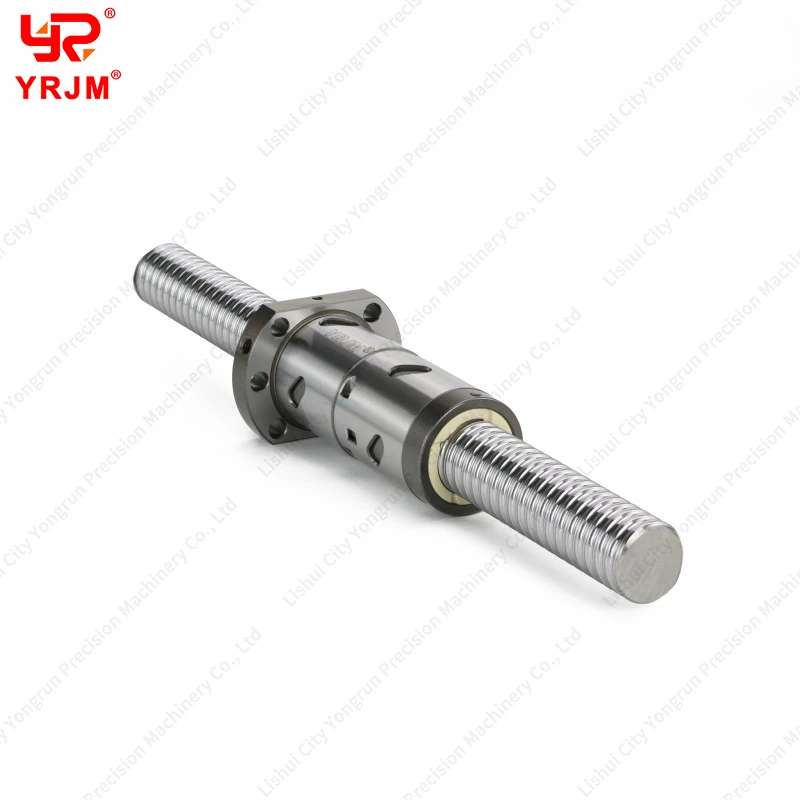
Ball screws serve as the primary drive mechanism in CNC machine tools, automation equipment, and high-precision positioning systems. While a ball screw's intrinsic manufacturing quality establishes its baseline capability, true in-system positioning accuracy and repeatability depend on the interplay of several mechanical, thermal, and environmental factors:
1. Lead Accuracy & Pitch Consistency
Lead accuracy is the deviation between the nut's actual linear travel distance and its theoretical target distance. Governed by international standards (such as ISO, DIN, or JIS tolerance classes C0 through C7), lead error consists of cumulative pitch error and localized travel variation (v300p). Specifying an appropriate precision grade (e.g., C3 or C5 for precision positioning versus C7 for general transport) directly dictates achievable positioning tolerance.
2. Backlash and Preload Management
Backlash refers to the axial internal clearance between the screw shaft, recirculating balls, and nut raceways. Uncontrolled backlash causes lost motion during direction reversals, degrading circular interpolation and bi-directional repeatability. Implementing a calibrated preload-either via oversized balls in single-nut designs or precision spacer shims in double-nut configurations-eliminates internal clearance and substantially increases axial contact stiffness.
3. Geometric Installation and Coaxial Alignment
Even a high-precision ground ball screw will underperform if mounted improperly. Angular misalignment, non-parallelism between the screw axis and adjacent linear guide rails, or poor mounting bed flatness creates cyclic radial side-loads. These parasitic loads cause elastic deflection, premature raceway wear, increased torque demand, and positional deviation.
4. Thermal Elongation and Temperature Stability
Friction from high-speed cycling, combined with ambient temperature fluctuations, causes the steel screw shaft to expand linearly (ΔL=α⋅L⋅ΔT). On long axes or high-duty systems, thermal elongation introduces noticeable position drift. Utilizing a fixed-supported mounting arrangement (such as BK/BF blocks), hollow-shaft coolant circulation, or prestretching techniques mitigates heat-induced buckling and drift.
5. Support Bearing Rigidity and Configuration
The overall drive stiffness is only as rigid as its end supports. Motor-end fixed support units (such as BK, EK, or FK series) utilize matched pairs of preloaded angular contact bearings to handle bi-directional axial thrust. Inadequate bearing preload, housing flex, or loose locknuts will introduce axial compliance that mirrors lead error.
6. Lubrication Regimes and Contamination Control
Insufficient or degraded lubrication breaks down the elastohydrodynamic oil film between the rolling elements and raceways, increasing friction, operating temperatures, and wear rates. Furthermore, particulate contamination from metal swarf or abrasive dust causes raceway pitting and seal degradation. Proper selection of lithium-soap grease or lubricating oil, paired with effective wiper seals, preserves motion smoothness and long-term repeatability.