
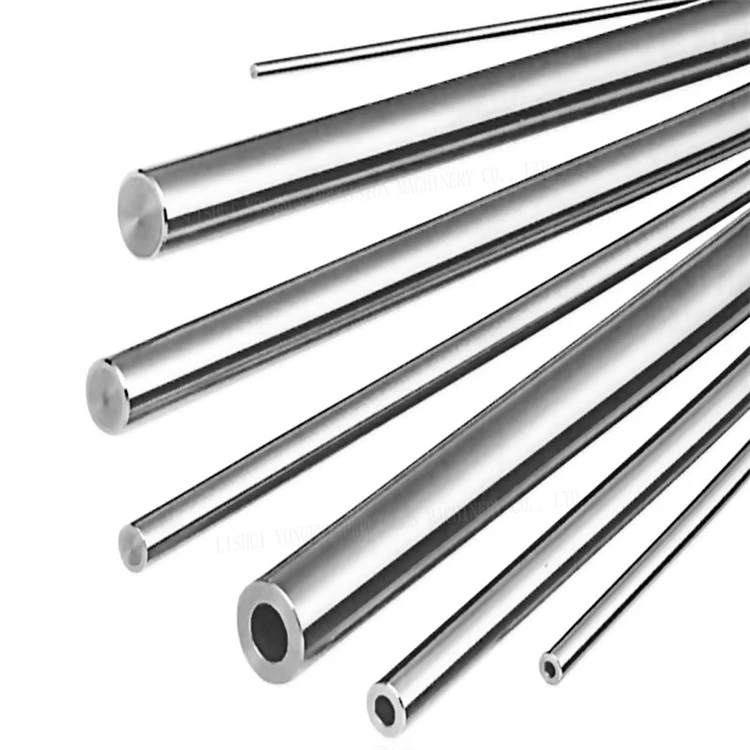
1. High-Speed, High-Dynamic Systems (Inertia Reduction)
In linear motion and automation systems requiring rapid acceleration, deceleration, or high-frequency direction changes, minimizing rotational inertia is critical. The torque required to accelerate a rotating component is directly proportional to its mass moment of inertia (I). By removing the lower-performing material at the center of the shaft, a hollow shaft significantly reduces total mass while maintaining its outer diameter. This lowers rotational inertia, allowing motors to accelerate and decelerate the system rapidly with reduced energy consumption.
- Typical Applications: High-speed pick-and-place robotics, semiconductor packaging, and printing presses.
2. Weight-Critical Environments (High Strength-to-Weight Ratio)
When overall system mass directly impacts structural load, transportation costs, or fuel efficiency, hollow shafts are preferred. Under torsional loading, shear stress is distributed asymmetrically across a circular cross-section, peaking at the outer periphery and dropping linearly to zero at the center. Consequently, the core of a solid shaft contributes minimally to torque transmission. For an equivalent weight, a hollow shaft can be designed with a larger outer diameter, yielding a substantially higher polar moment of inertia (J). This structural geometry provides superior resistance to both torsion and bending.
- Typical Applications: Aerospace components, automotive driveshafts, and high-end structural linkages.
3. Integrated Utility Routing
Many complex mechanical assemblies require electrical, fluid, or pneumatic lines to pass through rotating or sliding axes. The hollow bore of the shaft serves as a shielded, built-in conduit, eliminating external cable carriers that are prone to wear and snagging during motion.
- Common Uses: Routing electrical wiring or fiber optics for sensors, pneumatic or hydraulic lines for rotary actuators, and high-pressure cutting fluids for machine tool spindles.
4. Direct Shaft Mounting
In compact machine designs, simplifying the drive train by eliminating couplings is highly advantageous. Hollow shaft gearboxes and motors allow the driven shaft of the machine to pass directly through the motor bore. This direct connection eliminates intermediate couplings, belts, and pulleys, shortening the overall footprint, reducing potential concentricity errors, and eliminating traditional wear points.
- Typical Applications: Conveyor drives, industrial mixers, packaging lines, and robotic arm joints.
5. Vibration and Thermal Management
Removing core mass shifts the natural resonant frequency of the shaft, which can help mitigate system harmonics in sensitive environments. Additionally, the increased surface area of a hollow structure enhances heat dissipation.
- Typical Applications: Precision laboratory test rigs, medical diagnostic equipment, and optical alignment systems.