
Linear slider (or LSL) is a mechanical transmission component designed for linear reciprocation. It usually consists of a linear guide rail, a a carriage (slider), a pedestal and a drive mechanism. By utilizing an electric motor, ball screw, timing belt, or other driving methods, linear sliders can move a workpiece or devicemounted on a standalong a fixed path.
Linear slides are commonly used in automated production lines, precision positioning systems, inspection equipment, robotics and mechanical processes. Because different applications require different driving distance, load capacity, speed and positioning accuracy, suitable structures and drive mechanism must be selected according to the specific operating conditions of the equipment.
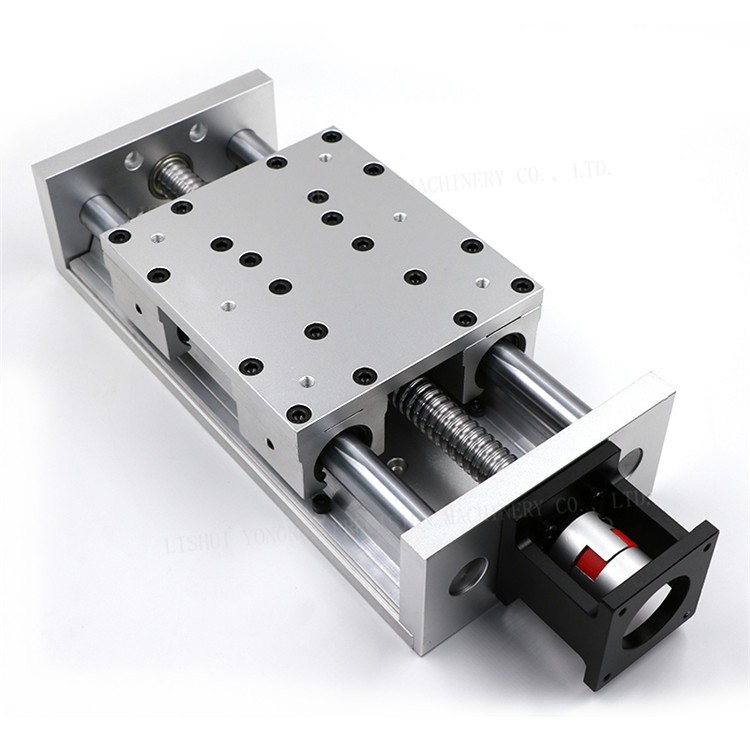
1.What is the basic structure of a linear slider?
Linear sliders generally comprise core components such as pedestal, linear guide rail, a carriage (slider) and drive mechanism.
The base is used to support the entire motion mechanism and connect it to the body of the device. Straight line guide rails and pulleys restrict the direction of movement, allowing the platform to move smoothly along the specified path. The driving power powers the movement.
Depending on the product design, linear sliders can also include components such as motor mount, couplings, limit switches or an encoder. When used in automated devices, it can be integrated with control system to manage location, speed and range.
2.How do linear sliders work?
The basic operating principle of linear sliders is to convert rotational motion-or other forms of power-into linear motion.
For example, in an electric slide driven by ball screw, the motor rotates the screw, and the nut mechanism converts this rotation into a straight line motion that pushes the slide along the guide rail. In a version of the timing belt, the motor drives the belt, which then moves the platform in a linear manner.
Different drivers have distinct characteristics. Ball screw drive is generally more suitable for situations that require positioning accuracy and high thrust, while timing belt drives is generally more suitable for situations that require longer travel distances time and higher movement speeds.
3. What are the main types of linear slides?
According to its drive mechanisms and operation method, linear slider can be divided into manual linear slider, electric linear slider, ball screw driven linear slider and timing belt driven linear slider. Manual linear stages are usually adjusted by a handwheel or similar mechanism; they are ideal for laboratory equipment, inspection fixtures, and applications that require manual positioning.
In contrast, linear motor is an ideal choice for automatic equipment by using stepper motors or servo motors.
If the client prioritizes positioning accuracy, repeatability, and motion stability, a lead-screw driven mechanism is a good option. Conversely, if requirements tend to run over long distances and at high speeds, solutions such as a synchronous (timing) belt drive may be more appropriate depending on the load.
4. What are the types of devices used in linear phases?
Linear stages have a wide range of applications, often found in automated production equipment, inspection systems, precision machining tools and industrial robots.
In automated production lines, linear stages are used for tasks such as workpiece handling, positioning, loading andunloading, and assembly.
In a visual inspection systems, a linear phase can move the camera or the product being inspected along a linear path, allowing inspection at different locations.
In laser processing, dispensing, welding and cutting equipment, linear phase is used to move the processing head along a pre-programmed trajectory.
In addition, linear phases of various specifications were incorporated into laboratory equipment, semiconductor manufacturing tools, 3C electronics production machinery and packaging equipment to tailor specific movement requirements.
5. How to select linear stages according to device requirements?
When choosing a linear phase, we should not focus on size or price solely, but rather assess the actual operating conditions.
First, determine a valid itinerary-the actual distance the stage needs to move. Secondly, the weight of the load is calculated, taking into account the inertia and dynamic load generated during the movement.
In addition, the operation speed, acceleration, positioning accuracy, repeatability, installation orientation, daily work frequency and other factors are taken into account.
If this phase will be paired with a servo or stepper motor, make sure the motor installation configuration is compatible with the driver interface. For space constraints devices, the overall height, width, and installation hole type of the linear phase must also be considered.
As suppliers, we usually advise customers to provide the equipment's structural drawings, as well as detailed information about load, trip, speed and accuracy requirements. This allows us to recommend the most appropriate linear phase for specific applications, rather than relying on a single dimension for selection.
6.What precautions should be taken when using linear phases? In long run, it is necessary to ensure that the linear guide rails and drive mechanism are in good working condition.
Parts such as guide rails, sliders and lead screws should be checked regularly for abnormal noise, vibration or resistance. If lead screw drive are used, they must also be lubricated and maintained in accordance with manufacturer's specifications.
Due attention must be paid to the smoothness and overall installation accuracy of the mounting base. Significant deviation of the mounting surface will increase motion resistance and adversely affect the positioning accuracy and service life of the components.
For automated equipment operating at high speed, overload or high frequency, linear slide unit with appropriate specifications must be selected based on actual life cycle to avoid long-term overloading.
Frequently Asked Questions
Q1: What is the difference between a linear guide rail and a linear slider?
The linear guide rail mainly provides guidance and load bearing support for linear motion. By contrast, a linear slide unit is a complete motion module-usually consisting of a base, guide rail, and drive mechanism-that can be integrated directly to achieve linear positioning and movement.
Can linear slide units be used in high-precision devices?
Yes. ' By combining proper guide rails, lead screw, encoder and transmission system, linear slide units can be used for applications requiring high positioning accuracy and repeatability.
Can a servo motor be mounted on linear slide unit?
Yes; however, the selection must match the the slide unit's structure, the motor's mounting dimensions and the transmission method. Servo motors are generally suitable for situations where speed, position and dynamic response need to be precisely controlled.
Q4: Is the trip (itinerary) of the linear slide unit customizable?
Many linear slide units can be customized according to the specific space constraints and movement requirements of a customer's equipment. This includes adjusting trip distances, installation configurations, motor setup, and other structural parameters.
Q5: What parameters should be provided when purchasing linear slide unit?
Details such as load weight, effective driving distance, operating speed, positioning accuracy, installation orientation, operating frequency and motor requirements are recommended. Providing equipment drawings or the size of available installation space can also assist suppliers choose the appropriate model.