
Linear slider is a kind of mechanical module used to realize linear motion and precise positioning. Widely used in automation equipment, inspection systems, precision machining tools, robots, electronics manufacturing equipment and other fields. According to the drive mechanisms, structural design and application requirements of linear slider, the linear slider is divided into different types. Each type has different characteristics in terms of speed of movement, accuracy of positioning, load capacity and range of travel, so it should be selected according to the specific operating conditions of the equipment.
1.Manual Linear Slides
Manual linear sliding relies on handwheels, adjustment screws or other mechanical structures for positioning. They don't require engines or control system.
These slides are relatively simple in structure and are ideal for applications that do not require high speed and acceptable manual positioning,such as laboratory instruments, optical equipment, inspection fixtures and mechanical adjustment mechanisms.
The advantages of manual linear slide are intuitive operation, relatively low cost and easy maintenance. If an application requires frequent, automatic reciprocation, an electric linear slider is a more appropriate option.
2.Electric Linear Slides
Electric sliders utilize motors to automate linear motion. They can be integrated with control systems, allowing for precise and automatic control of position, speed and distance travelled.
According to specific requirements, different driving systems, such as stepper motors or servo motors, can be configured. Electric sliders are suitable for automated production lines, material handling mechanisms, dispensing equipment, inspection systems and precision positioning applications.
Electric linear sliders help reduce the need for manual intervention and improve the consistency of the production process for production equipment that must repeat the same movement path.
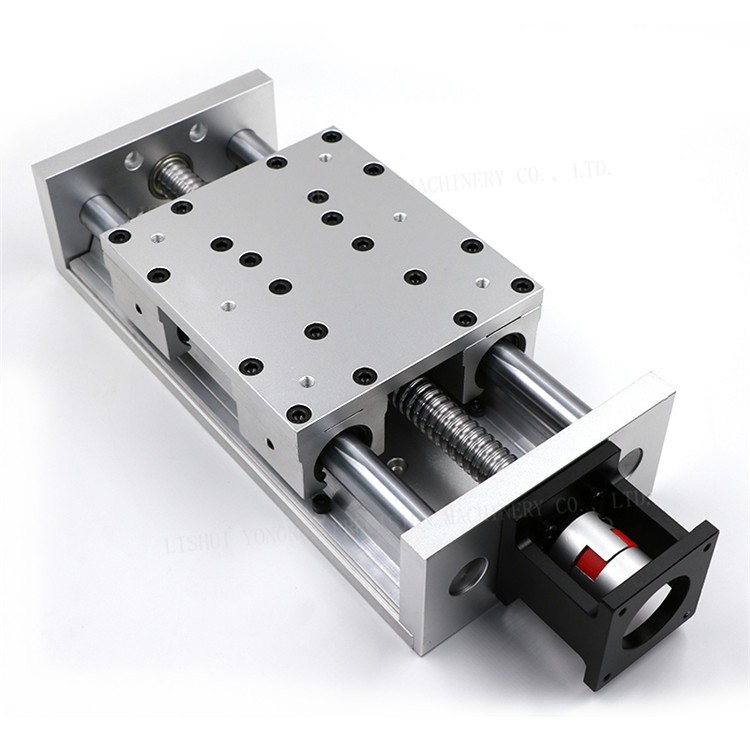
3. Ball Screw Linear Slides
Ball screw converts the motor's rotating motion into a straight line motion through the ball screw mechanism.
These slides are characterized by high transmission efficiency efficiency, excellent positioning performance, and provide stable and consistent linear motion. Therefore, they are often employed in applications that require high positioning accuracy and repeatability.
For example, automated assembly systems, precision inspection equipment, laser processing machinery and electronics manufacturing equipment, all of which can be designed utilizing ball screw. However, the actual speed, accuracy and bearing capacity of the ball screw segment also depend on screw specifications, guide rail structure, motor and control system, and the final performance cannot be determined by the mere presence of ball screw.
4. Synchronous Belt Linear Stage
Synchronous belt linear stage uses timing belt to transfer power, driving stage along the guide rail linear movement.
Compared with ball screw configuration, synchronous belt systems is generally more suitable for long trip and high-speed linear movement, such as material handling, automated loading/ unloading and unloading, visual inspection and packaging equipment.
Positioning accuracy requirements are not extremely strict for scenes that require rapid movement, and the synchronous belt stages provides excellent overall performance.
If the equipment requires to run over long distances, specific timing belt specifications must be selected based on load, speed, acceleration and frequency of operation.
5. Linear Motor Stage
Linear motor stages produces linear motion directly through electromagnetic force and no longer needs the traditional ball screws or timing belts as the main driving element.
The structure is characterized by high response speed, smooth movement, and is suitable for high-speed, highly dynamic applications, making it suitable for precision inspection, semiconductor equipment, electronics manufacturing, and some high-end automation systems.
Linear motor stages usually requires more control system, installation precision and operating environments, and its procurement costs may exceed that of traditional mechanical transmission system; therefore, it should be selected according to actual performance.
6. Multi-Axis Linear Stage Assemblies
If the single-axis stage doesnot meet the spatial motion requirements of the device, multiple linear stages can be combined into 2D or 3D motion platforms.
For example, combining two stages causes X-Y to move while adding a vertical axis creates an X-Y-Z triaxial movement mechanism.
This configuration is common in dispensing, laser processing, visual inspection, automatic drug withdrawal and laboratory equipment. When designing a multi-axis system, potential mechanical interference between load, speed of movement, orientation of installation and axis must be taken into account.
How to choose the Right Linear Stage?
No linear phase is intrinsically superior to others; the key is to find the type that works best for a particular application. If manual fine-tuning is the main requirement, a manual linear phase is an appropriate option; for automatic positioning, a linear phase is preferred. When higher positioning accuracy is required, the Ball screw mechanism is ideal, while synchronous belt mechanisms is more suitable for long stroke and high operating speeds. For applications requiring high speed, high dynamic and high precision, linear motor solutions should be considered.
As linear stage supplier, we typically recommend that customers provide parameters such as load, stroke, speed, positioning accuracy, repeatability, installation orientation, and frequency of work. For custom automation equipment, providing installation space dimensions and equipment drawings helps select the most appropriate phase configuration.
Frequently Asked Questions
Which is better, the ball screw stage or a synchronous belt stage?
They apply to different applications. Ball screw stage is usually suitable for applications that give priority to positioning accuracy and stability, while synchronous belt stages is usually suitable for long stroke and high-speed movement. The selection should ultimately be based on specific equipment parameters.
Q2: Can manual linear stages be converted to electric?
Some designs allow motorization, but factors such as installation size, drive mechanism and motor connection method must be verified. For new devices, it's often easier to choose the right electric phase from the start.
Q3: Can linear stages achieve multiaxial motion?
Yes. ' Multiple single-axis levels can be combined to meet specific motion requirements to achieve multiaxial linear motion, such as XY, XZ, or XYZ configurations.
Q4: How is the linear phase schedule determined?
This should be determined based on the physical distance the equipment needs to move, taking into account the necessary safety margins. Journey length should not be based solely on workpiece dimensions; fixtures, mounting position and overall range of motion must also be considered.
Question 5: Can linear phases be used in high-speed automated devices?
Yes, but drive mechanism, guide rail and motor must be selected according to high speed requirements, with careful consideration of load, acceleration, stroke and frequency. Vibration and positioning stability are also important considerations for high-speed applications.