
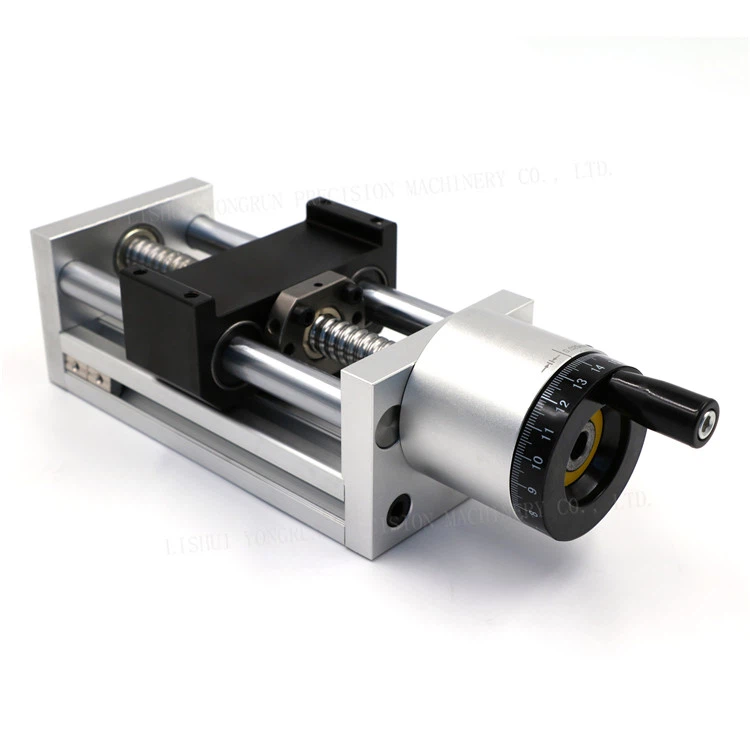
Key Advantages of Manual Linear Stages
1.Zero Electrical Noise & Vibration:
Unlike electric motors-which can induce high-frequency micro-vibrations and Electromagnetic Interference (EMI) even when stationary-a manual stage is an entirely mechanical system. Once positioned, the stage remains completely inert and free from electrical noise, ensuring absolute stability for sensitive optical and metrology applications.
2.Ultimate Simplicity & Cost-Efficiency:
Manual stages provide a streamlined "plug-and-play" solution. By eliminating the need for power supplies, motor drivers, complex controllers, cabling, and software integration, you significantly reduce your total Bill of Materials (BOM) and eliminate hours of electrical assembly and debugging time.
3.Self-Locking Stability:
Most industrial manual stages utilize precision-engineered trapezoidal lead screws or high-resolution micrometer threads. Due to their high internal friction and fine pitch, these mechanisms are naturally self-locking. They resist external pushing forces and vibrations, holding their position rock-solid without the need for an electromagnetic brake or constant power.
4.Tactile Feedback & Micro-Precision:
Manual stages offer the operator direct, tactile control. When paired with high-resolution micrometer heads or digital position indicators, users can feel mechanical resistance to dial in adjustments with sub-micron accuracy (down to 0.001mm), providing a level of intuitive control that is difficult to replicate with motorized systems.