
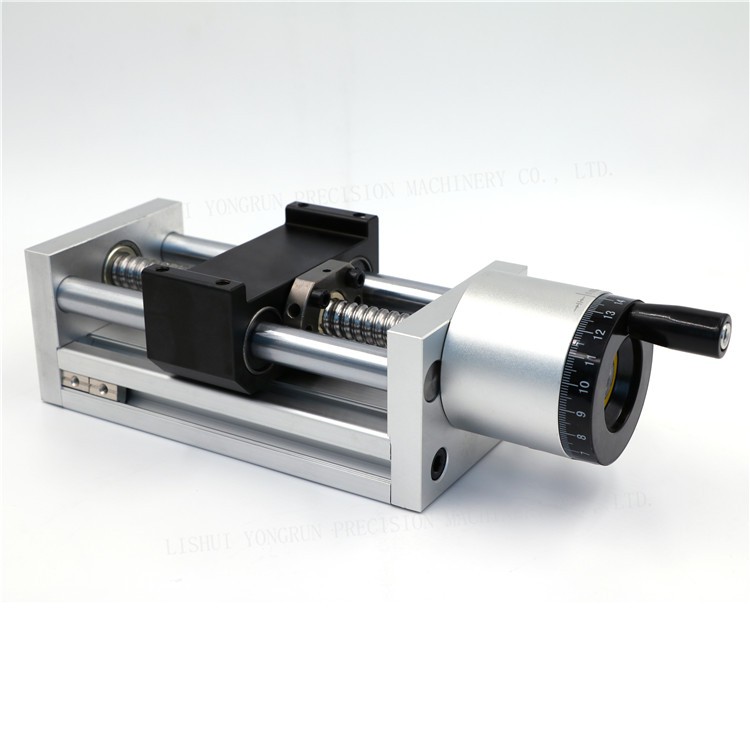
1.Zero Electrical Complexity & Cost-Efficiency:
Manual stages provide a streamlined, out-of-the-box solution, eliminating the need for motor drivers, power supplies, complex cabling, and software integration. By removing the electronic control architecture, manual stages represent a significant reduction in total Bill of Materials (BOM) costs and drastically accelerate time-to-market.
2.Absolute Mechanical Stability (Self-Locking):
Unlike servo systems, which may experience "hunting" or "jitter" while maintaining a position, manual stages are inherently stable. Engineered with trapezoidal lead screws, these units leverage high-friction thread angles to provide a natural self-locking capability. Once adjusted, the carriage remains locked under load without the need for electromagnetic brakes or continuous power, ensuring zero-drift performance.
3.Zero Electromagnetic Interference (EMI):
For sensitive applications in metrology labs, semiconductor inspection, or electron microscopy, electrical noise is a critical failure point. Manual stages offer a 100% mechanical drive system, generating zero EMI and zero thermal output. This makes them the gold standard for environments where electrical fields or heat could distort sensitive sensor readings.
4.Tactile Control & Micro-Precision:
Manual stages provide intuitive, human-in-the-loop control. When paired with high-resolution micrometer heads or digital position indicators, these stages allow operators to achieve micron-level adjustments (0.01mm) with direct tactile feedback, enabling the fine-tuning of laser heads, welding torches, or optical equipment that motorized systems may struggle to replicate.
5.Infinite Environmental Versatility:
Manual stages are inherently robust and require no climate control or electrical sealing. They are intrinsically safe for explosive (ATEX) environments-such as paint booths or grain silos-where electric sparks present a lethal risk. Furthermore, they are ideal for remote, off-grid field equipment where power infrastructure is unavailable.